Sermon for the Twenty-First Sunday after Pentecost
Sermon for the Twenty-First Sunday after Pentecost – October 18, 2026
Matthew 22:15-22
Dear friends, grace to you and peace from God our Father and our Lord Jesus Christ.
We have a hot button issue here in Washington state coming up on the ballot this November. Initiative 645 will ask voters to repeal the state’s new 9.9% tax increase on individuals making over one million dollars. You’ve probably seen ads about this on TV or your mailbox or popping up in your social media feed.
Let me try to give you a measured, non-partisan description of both sides of the debate.
Those who like this way of taxing our citizens and want you to vote “no” on the initiative point out that this new tax is far better in terms of fairness than the more regressive current system of relying on a sales tax and property taxes, which take up a larger percentage of lower income households. It’s about wealthier individuals paying their fair share, they would say. Those who don’t like the tax and want you to vote “yes” on the initiative argue that this is just foot in the door to a more widespread income tax on top of most of those other taxes, and that this will drive job-creating capital out of the state, which will hurt everyone by hurting our state’s economy.
I hope that was an unbiased and fair description of the two sides.
Now let me tell you how I think you should vote on it….
Just kidding. We have other things to focus on here, don’t we?
In our gospel reading for today we hear the Pharisees try to trap Jesus by drawing him into a debate about one of the hot button issues of his day, which also happened to be a debate about taxes. They asked him: “Jesus, good teacher, is it lawful to pay taxes to the emperor or not?” When they say “lawful” here, they are referring to Biblical law. Essentially, they were asking whether it was sinful.
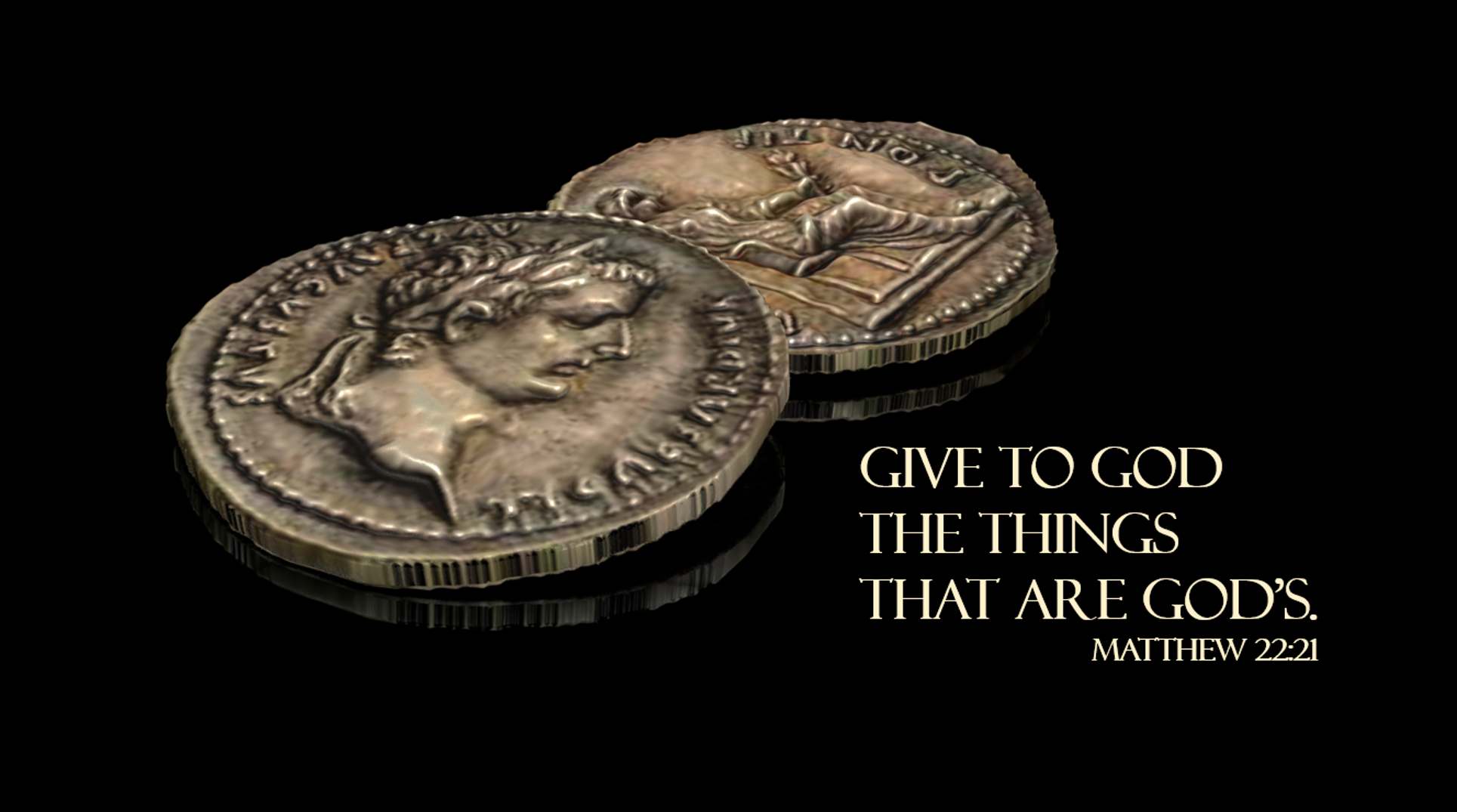
Many Jewish people despised paying taxes to Rome, believing that it was sinful. They didn’t like having to carry around coins with a picture of the emperor on it and slogans proclaiming him to be a god. They also didn’t like having to fund their own oppression by paying them taxes.
But not everyone hated paying these taxes. Some Jewish people were okay with it. The Herodians, the ruling class, saw some advantages to having Rome in Israel. The Herodians were a sort of puppet government of Rome, and willingly so. They believed the Roman Empire brought with it some benefits.
It’s like that scene in Monty Python’s “Life of Brian,” set in Israel in the time of Jesus, where one of the Jewish characters says, “What has Rome ever done for us?” And his Jewish friend says, “Well, there’s the aquaducts, and sanitation, and the roads, and irrigation, and medicine, and education.” The Herodians thought paying taxes to Rome was a good deal.
“So, Jesus,” the Pharisees asked, “what do you say? Is it lawful to pay taxes to the emperor or not?”
This was a hot button issue. There was a lot at stake in Jesus’ answer. If Jesus said it was lawful to pay the tax, he would be seen by many as advocating idolatry and being complicit with a foreign enemy, which would get him into trouble with many in the crowd. If he said it was unlawful and that they shouldn’t pay it, he would be seen as a revolutionary and handed over to the Roman authorities.
Remember, the Pharisees asked him this question to trap him. They wanted to throw him in the middle of this debate so they could watch him get torn apart. Either way he answered would get him in big trouble, and they would be rid of him at last.
The first thing Jesus did in response was to bluntly call them hypocrites. He knew they all had those idolatrous coins jingling in their own pockets. Jesus asked for one of them. Then he asked whose image was on it. When they answered, “The emperor’s,” he said, “Then give to the emperor the things that are the emperors and give to God the things that are God’s.”
What does this mean, exactly? It sounds like some kind of riddle. Technically, everything belongs to God! Every Jewish person knew that! So, was it lawful to pay the tax, or not? Both sides seem to have been scratching their heads over Jesus’ answer. Neither side got upset. The Pharisees were amazed that he managed to step around their trap. They left him and went away.
But Jesus answer was so much more than an artful dodge. “Give to the emperor the things that are the emperor’s and give to God the things that are God’s” is not really a riddle. Instead, Jesus was redirecting the focus of the conversation to something even more urgent. Jesus cut through the heat of that hot button issue to focus on something bigger. The bigger question for Jesus wasn’t whether they should give the emperor his coin; it was whether they were giving themselves to God.
You see, the coins they had might have carried the image of the emperor, but they themselves carried the image of God. The people themselves, with their talents, their gifts, their resources, their lives – they bore the image of God! As it says in Genesis 1:27, as the first human beings were created, “So God created humankind in his own image, in the image of God he created them.”
“Give to God the things that are God’s,” Jesus says. Just as the coins bear the image of the emperor and should be given to him, human beings bear the image of God – and so we are called to give our whole entire selves to him. We are to dedicate everything we have, everything we are, to God, whose image we bear.
In his book, “Giving to God,” Mark Allen Powell tells a story about the mission work done among the Gauls in medieval times. The Gauls were a bloodthirsty people living in what is now France and Belgium. Christian missionaries entered the region to share the gospel and were very successful. Many of the Gauls converted to Christianity, even many of their warriors. Before sanctuaries with baptismal fonts, baptism took place by full immersion in a river or a lake, and when the warriors were baptized, many of them insisted on leaving their right arm out of the water. They explained that they wanted to leave one arm unbaptized so that they could continue to slay their enemies without mercy.
Powell suggests that this is more of a medieval version of an urban legend than historical fact, but it does provide a striking metaphor for something that afflicts God’s people of all times and places. We don’t want to give our whole selves to God. We might not leave one arm unbaptized so as to keep on slaying our enemies without mercy, but we are very good at compartmentalizing our lives, leaving God out of certain parts. We all hold back parts of ourselves from God so we can keep on doing some things our own way.
“Give to God the things that are God’s,” Jesus says. That means everything. It means both arms. It means every body part. It means every last part of you, every last part of your life. It means your entire, undivided heart. It means all your talents. It means all your treasures, all your coins – no matter whose face is on them. This doesn’t mean all or even most of our money needs to be given to the church, but all of it is to be used for the glory of God. Our whole lives are to be given over to God in joyful obedience. We were made in the image of God, and so we are to give ourselves, every last part of our lives, to him.
So didn’t Jesus care about the question at hand? Didn’t he care about that hot button issue? Didn’t he care about the difficult position the Jewish people were in as they had to carry this idolatrous money around in their pockets all the time, money they had to use to fund their own oppression?
I’m sure he did. But Jesus didn’t come into the world to sort out those problems, as pressing and difficult as they were. Jesus didn’t come to be an activist or a community organizer or a social revolutionary. Jesus came to do something much bigger. Jesus came to conquer a much bigger enemy. Jesus came to save the Pharisees from their hypocrisy. He came to save the Herodians from their complicity. He came to save ordinary Jews from their idolatry. He came to save all human beings from their sin.
Jesus didn’t come to overthrow Rome, he came to overthrow the power of sin, death, and the devil. He didn’t come to offer his thoughts on the tax code, he came to collect for God all the precious human beings made in God’s image. And when we refused to give ourselves entirely to God, he gave himself entirely for us on the cross.
As Christians we are called to be good citizens, and part of being a good citizen is paying your taxes. How much we are taxed and how we are taxed is open for debate. Christians can and do disagree about it. I’d even bet that many of us right here in this sanctuary probably disagree about the tax issues of our time as much as the Pharisees and the Herodians disagreed about the tax issues in their time.
But we can’t fall into the trap of turning our time with Jesus into an argument over hot button issues, at least not here in worship. Worship is where Jesus comes to speak to us, and when the Lord Jesus comes with his Word for us, he has bigger, deeper concerns in mind.
Today our Lord Jesus reminds us of something we forget all the time: that we are made in the image of God – every person, every body part, every cell. In Holy Baptism Jesus goes a step further and inscribes his name on us, so that we would be certain that we belong to him!
“Give to God the things that are God’s,” Jesus says to us today. God wants more than chump change. God wants you. Through the saving work of his dear Son, he has claimed you, he has redeemed you, he has saved you, he has cleansed you through the forgiveness of sin, he has made you his own.
Your whole self, body and soul, belongs to God.
So give to God the things that are God’s.
Thanks be to God. Amen.
Rev. Jeffrey R. Spencer
Oak Harbor Lutheran Church