
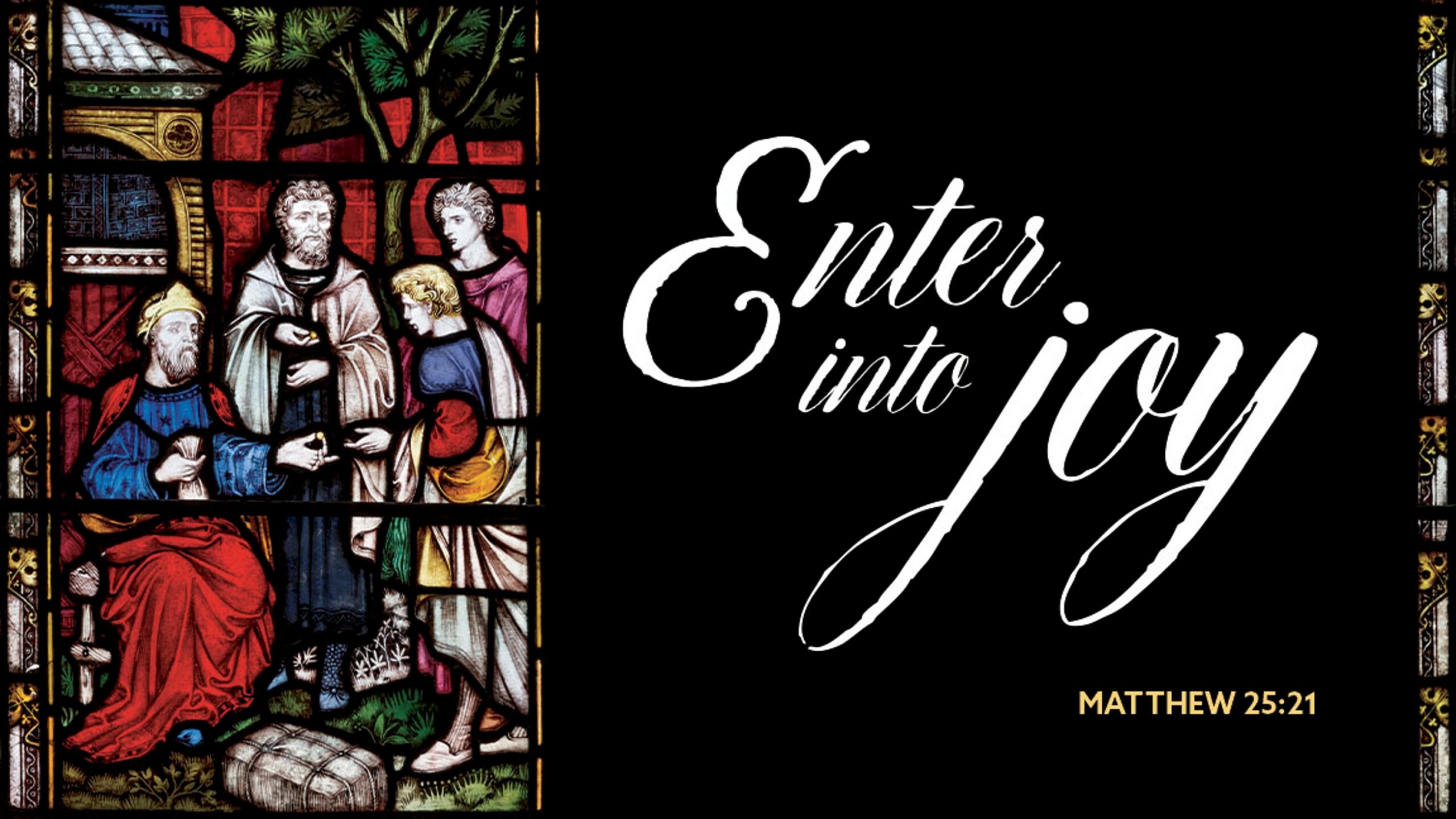
Sermon for the Twenty-Fifth Sunday after Pentecost
Matthew 25:14-30
Dear friends, grace to you and peace from God our Father and our Lord Jesus Christ.
Our Master, the Lord Jesus Christ, is a venture capitalist.
Venture capitalists put their resources to work. They put their wealth into circulation. They invest in projects that expand the economy. Venture capitalists do not put their money in a safe-deposit box. They do not hide it under their mattress. They do not bury it in the back yard. They put it out there. They put it to work. They get it out there in the market where it can generate more wealth.
This is precisely what happens in the parable we hear today from our Master, the Lord Jesus. The master in the parable entrusts his riches to three servants. I know the NRSV translation I read from and which appears in your bulletin translates it as slaves, but that word often brings to mind chattel slavery – and that is not what is going on here. These were more like indentured servants. They were bound to their masters, but they were bound by contracts, not by chains.
These three servants were given enormous amounts of money. In English, the word “talent” refers to a skill, like tap dancing or juggling or playing the violin. But that’s not what “talent” means in this parable. A talent here is a monetary unit. It is a sum of money. One talent represented about twenty years of wages for an average laborer. So, to put this in contemporary terms, the servant who was given five talents (which was 100 years’ worth of wages!) was given roughly $5 million dollars. The servant who was given two talents was given roughly $2 million dollars. The servant who was given one talent was given $1 million dollars. This wasn’t pocket change! These were enormous amounts of money. Even the third servant, who was given significantly less than the others, was given a million dollars! That’s still a huge investment!
The Master doesn’t give them these enormous amounts of money so that they can sit on them. He is a venture capitalist! He wants this money to be put into circulation. He wants it to be invested. He wants it to be used to grow the economy.
The first two servants understood this. They put this money to work. They invested it. They put it into circulation. They put it on the market, trading with it, and both of them doubled their money! The one with five talents made five more – turning $5 million dollars into $10 million dollars. When the master returned and saw this return on his investment, he said, “Well done, good and faithful servant! Enter into the joy of your master!” The one with two talents made two more – turning $2 million dollars into $4 million. In the same way, when his master saw this, he said the same thing to this servant: “Well done, good and faithful servant! Enter into the joy of your master!”
Then there is the third servant. What did he do? He literally buried his money in the ground. He took that $1 million dollars and dug a hole in his back yard and he hid it. We’ll come back to this, but for now let’s just note that the master was not happy.
Our Master, the Lord Jesus Christ, is a venture capitalist. But the riches he has given to his church are not monetary sums. They are not worldly riches. The church exists in the world, and so we absolutely do need money to keep the lights on and to carry out our mission. But the riches entrusted to us by our Master go far beyond the offering plate and our bank account. Our Master has given us wealth of a different kind. I think Ephesians 2 would have been a great epistle reading for today, because there the apostle Paul talks about how God is rich in mercy. Paul talks about how great God’s love for us is in sending us his Son. He talks about “the immeasurable riches of his grace in kindness towards us in Christ Jesus.”
These are the riches our Master has entrusted to us. These riches are given to us in many ways. They are given through Holy Baptism, where the waters of grace flood over us in abundance. They are given through the Absolution, the announcement of forgiveness commanded by Christ himself. They are given through the Lord’s Supper, where we are given Christ’s own precious body and blood for the forgiveness of our sin. Every time we open the scriptures, the treasure of God’s living Word comes pouring out, guiding us, teaching us, comforting us, assuring us, showing us how rich God is in mercy, how great his love is, how immeasurable are the riches of his grace. These riches are also given through the fellowship of believers, which is so valuable, which is worth so very much!
These riches are not meant to be hidden away in a safe-deposit box. They are not meant to be buried in the back yard. They are to be put into circulation. They are to be put to work to grow the economy of grace, to multiply the riches of God’s love.
When we forgive one another, we are passing along the precious gift of forgiveness we ourselves have received. When we welcome visitors and newcomers, we are extending the hospitality of Christ. When we comfort someone who is grieving, we are putting the riches of God’s promises to work. When we teach children the faith, we are placing the treasures of the Gospel into another generation’s hands.
This isn’t necessarily a numbers game. The return on investment isn’t always a matter of numerical growth. Often, it is more about making investments in people, investments of love and care which help God’s love multiply in someone’s life.
In recent weeks we have had a few services with one or zero children coming up for the children’s sermon. We are struggling to find enough committed families to pull off a Sunday School Christmas program this year. I think we’ll pull it off, but it has been a challenge. It is hard not to be discouraged by that. It is frustrating to not see more of a return on some of the investments we have made.
But just this week as I was moping about this, I had one of our younger new members come up to me to tell me how much this congregation has meant to her. She told me how much God’s love has been made real for her here. She had tears in her eyes as she told me this. That’s how much it meant to her. You did that. You did it by investing in her. That investment is paying dividends!
Also, this week Sharon Erickson sent me an encouraging article. (God seems to know when I’m getting mopey and often sends me angels like these two to cheer me up.) The article was titled, “OK…Listen up, Lutherans!” There are too many good points in the article to convey them all, but one line stood out to me. The author wrote, “What if we stopped measuring the vitality of our congregations primarily by how many people come through our doors and started asking how much love goes out of them.”
Numbers matter, to be sure, but this is another, perhaps more important measure of what it means to grow the economy of grace. This is what it means to get the riches of the gospel out there, putting it to work. This is what it means to get a return on Christ’s investment. It means investing in people so that they walk out of here loved, and thus ready to love others.
Let’s go back to the third servant. What was his deal? He was afraid that his master would judge him based on his performance, based on the numbers he would put up. He saw his master as a harsh, demanding man. He was so afraid of coming up short that he didn’t do anything with what was entrusted to him. He buried those riches, believing that his master was a harsh and unforgiving man. And at least in terms of the parable, the master he believed in was the master he got.
But that’s not who our Master is. Our Master has given us the riches of his mercy. He has given us his great love. He has given us the immeasurable riches of his grace. And he has given us all these things so that we might invest them, so that we might grow the economy of grace, so that we might expand the reach of his love –
not only in raw numbers, but in the hearts of those God puts in our path.
Jesus is not literally a venture capitalist, of course. For the record, he isn’t a communist, either. Jesus didn’t come to redistribute global wealth or to juice the stock market. He didn’t come to run the Federal Reserve or to set monetary policy. But he did come with riches to be invested, and the wonderful thing about these riches is that the more we give away, the more there is to go around.
Our Lord Jesus has made an investment in you. He has made you his own. He has bought you, not with silver or gold, but with his own precious body and blood, given and shed for you on the cross. He has redeemed you, and so now you are his servant.
This Master of yours is not Don Corleone, ready to whack you if you don’t cough up his money with interest. Your Master is generous, loving, forgiving, and merciful. As St. Paul says in our actual epistle reading for today, “God has destined us not for wrath but for obtaining salvation through our Lord Jesus Christ, who died for us.”
And so, when he comes again, he will rejoice in you. He will rejoice in the faith he has created in you, and in the love and grace he has multiplied through you, often in ways you never even realized. He will say to you, “Well done, good and faithful servant. Enter into the joy of your Master.”
Thanks be to God. Amen.
Rev. Jeffrey R. Spencer
Oak Harbor Lutheran Church