
Sermon for the Twentieth Sunday after Pentecost
Sermon for the Twentieth Sunday after Pentecost – October 11, 2026
Matthew 22:1-14
Dear friends, grace to you and peace from God our Father and our Lord Jesus Christ.
I received a wedding invitation recently. My niece is getting married next month down in the Puyallup area. While this invitation didn’t come as a surprise, it was a joy to receive. It was a joy to be reminded that my niece and her fiancé want my wife and I to be there. It was a joy because we have a celebration to look forward to. It was a joy because I know we are going to eat well. It was a joy because we will get dressed up for the occasion. Once we knew what was expected of the guest attire, my wife immediately started shopping for slinky evening dresses. “Oh darn,” I lied. I am going to officiate the wedding, but even that feels like a gift. I baptized this dear niece of mine, and it will be a joy to speak God’s blessing over this covenant relationship too.
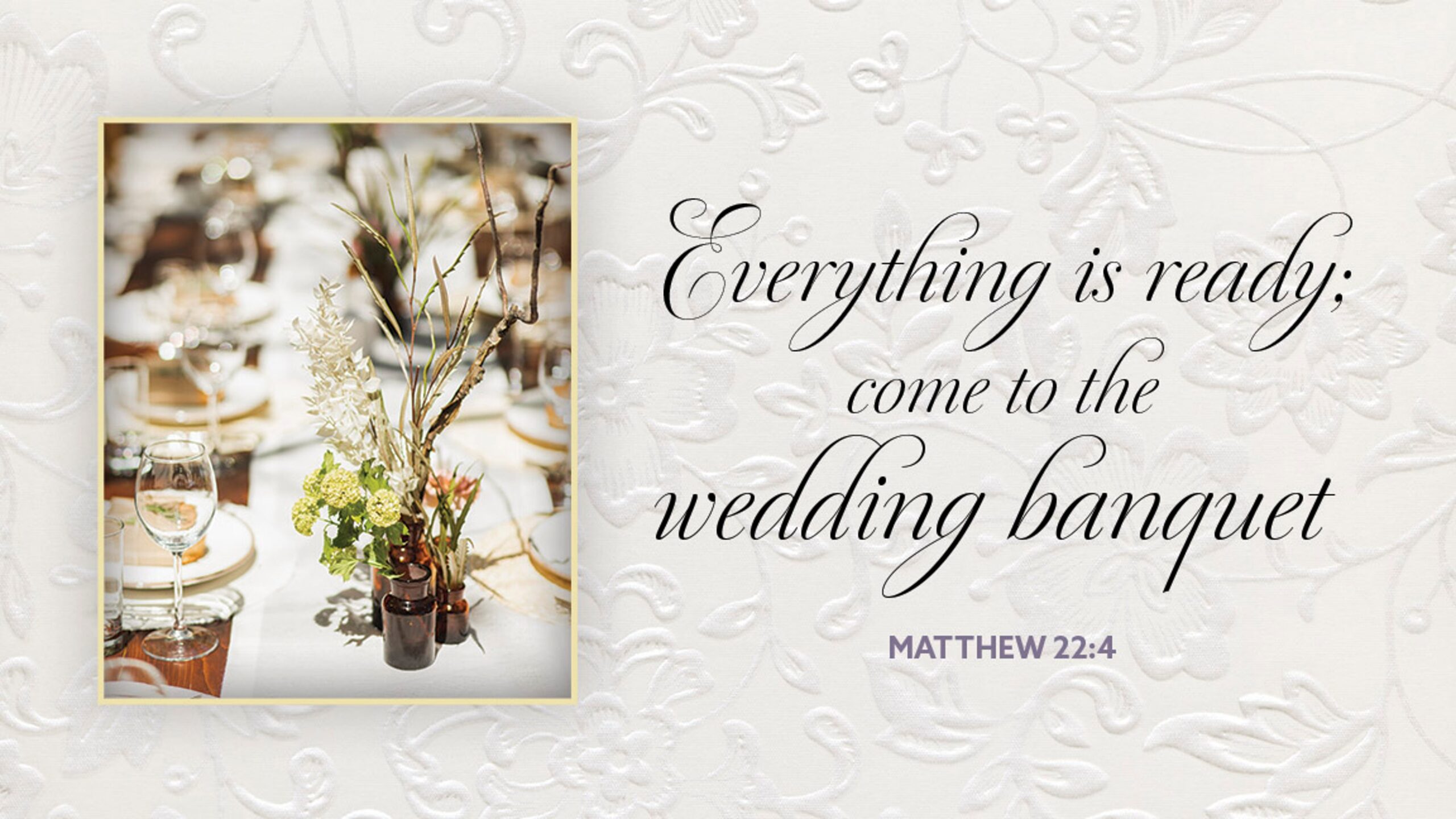
In our gospel reading for today Jesus tells a parable about a wedding invitation. This wedding invitation is sent out by a king. But instead of this invitation being received with joy, it is received with indifference. “They did not go,” it says. The king sent out a follow up invitation: “Look, the feast is prepared! The steaks are on the grill! It’s going to be great, so come!” But they made light of it. They thought they had better things to do.
There comes to be some skirmishing (to put it mildly) between those who are invited and the slaves the king sends out with the invitations, and eventually the invitations go out to strangers in the streets. The invitations go out to everyone, both good and bad, the deserving and the undeserving. Now there is a response. Now the wedding hall is filled with guests.
Jesus doesn’t pull the imagery for this parable out of nowhere. Just like with the vineyard parables we’ve been hearing over the last few Sundays, there is a long history of using wedding language to describe the relationship between God and God’s people. It is all over what we call the Old Testament. Again and again God is described as the husband, and God’s people are his beloved bride. For example, in Isaiah 54:5 the prophet says, “For your Maker is your husband, the LORD of hosts is his name.” And again in Isaiah 62:5, it says, “As the bridegroom rejoices over the bride, so shall your God rejoice over you.”
Feasts, whether wedding banquets or otherwise, are all over the Old Testament as well. There is a Messianic banquet, a feast of salvation, which is promised again and again. We hear one such invitation in our reading from Isaiah this morning: “On this mountain the Lord of hosts will make for all peoples a feast of rich food, a feast of well-aged wines, of rich food filled with marrow, of well-aged wines strained clear.” This is the great and coming Messianic feast. And who is this feast for? Who is invited? All peoples. All peoples. Just like in the parable.
What Jesus is doing with this parable is using this Biblical imagery to describe how God’s invitation to the Messianic feast has been received so far. God sent prophets to invite his people to prepare for the wedding banquet, to come to the feast. Again and again, those invitations were met with indifference. The prophets were ignored. Sometimes God’s messengers were attacked or even killed.
Now the King’s Son has come. John the Baptist had been inviting people to the wedding feast, specifically identifying Jesus as the groom, saying, “He who has the bride is the bridegroom.” (John 3:29) The Father’s wedding feast for his Son was at hand, but those who were on the guest list were indifferent to his invitation.
Now others were being invited, and they were not the people you’d expect. They were not the chief priests and the elders, who had been tossing their invitation out with the junk mail. These were ordinary people off the street – both good and bad. They were responding to the invitation. They were coming to the wedding feast. They were eager to celebrate with the King’s Son.
The parable ends with a little twist. One of the attendees wasn’t wearing the appropriate guest attire. He went strutting into this formal banquet wearing a hoodie and jeans! He hadn’t put on the wedding robe, and it appears that he had no intention of doing so. This wasn’t a mistake. He didn’t misread the invitation.
It wasn’t that he didn’t have access to a wedding robe. Apparently, he just didn’t want to wear one.
When the king saw him, he wasn’t angry at first. He addressed him as a friend. “Friend, how did you get in here without a wedding robe?”
Our version of the parable then says that this inappropriately dressed guest was speechless – which isn’t a great translation. To say he was speechless makes it sound like he was bewildered or confused or maybe even scared. But that’s not what is going on here.
This guest was responding with quiet indifference to the king’s stated dress code. He was giving the king the silent treatment. He was blowing him off, ignoring him. He thought he could be there on his own terms. He thought he could be there wearing whatever he wanted. He thought his own regular clothes were good enough. As the parable ends with security escorting him out of the wedding, he finds out that this is not the case! If you’re going to be at the wedding of the King’s Son, you are going to be dressed appropriately!
This sounds harshly judgmental, but again Jesus is drawing on well-established, well-known Biblical imagery. God is often described in the Old Testament as the one who clothes his people in salvation. To draw once again from Isaiah, in chapter 61 the prophet says, “[The LORD] has clothed me with the garments of salvation; he has covered me with the robe of righteousness.” This is only one of many, many examples of this imagery of being clothed by God in salvation, being clothed by God in righteousness, being clothed by God in grace as a gift.
This is the wedding robe! This is the proper attire! All he had to do was receive the garment of salvation as the gift that it was. All he had to do was be willing to be clothed in grace.
All are invited to this wedding – both the good and the bad. But there is one requirement: You need to be clothed properly. And when it comes to the wedding banquet of the King’s Son, that garment is the grace of Jesus Christ, the bridegroom. That garment is the righteousness of Christ, won for you on the cross, which covers your sin and makes you worthy to join the feast. That garment is the robe of salvation, which is given to you by God as a gift and is received in faith.
The invitation to the wedding banquet of the Son is extended to all people. Sadly, it is still true that many receive this invitation with indifference. Sadly, some think they have better things to do. “Sorry, I need to catch up on some work.” “Sorry, my kid has a soccer game.” “Sorry, I just don’t feel like coming.” Sadly, some still receive this invitation with hostility, attacking those who have been sent with a Word from God.
Sadly, some don’t remain at the banquet because they would rather do things their way rather than let themselves be clothed by God in the gracious robe of righteousness won for us by the Lord Jesus.
What about you?
So, I will be going to my niece’s wedding in a few weeks. She wants me there! I have an invitation! This is an invitation to celebrate. It is an invitation to feast. It is an invitation to share in their joy, the joy of their covenant relationship. We are happy to go, and when the day comes, we will be dressed appropriately in our wedding attire.
This invitation from my niece is a faint reflection of the invitation that comes to all of us through our God and King. Just as everyone in the parable was invited to the wedding feast of the King’s Son, so too have we been invited – all of us! All of you! All people!
This wedding feast is both now and not yet.
It is here now in the feast of the Lord’s Supper, where we are fed with the rich food and the well-aged wine of salvation – Christ’s own body and blood. This is a foretaste of the wedding feast to come.
But there is more to come! Jesus says that this parable we’ve heard today is a parable of the kingdom of heaven. When the kingdom of heaven comes in its fullness, when we enter fully into the presence of God our King, that’s when the real party begins. That’s when we will feast forever in celebration of our eternal covenant with God. For now, we get a foretaste of the wedding feast to come.
You have been invited to this wedding. You are already dressed for it, whether you realize it or not. In Holy Baptism you were clothed in Christ. You were robed in his righteousness. He has clothed you in his forgiveness. He has made you worthy of this grand affair by draping you in his grace.
You have been invited because both the King and his Son want you to be there! Don’t receive this invitation with indifference. Don’t toss it out with the junk mail.
Instead, receive it with joy and come to the feast. Come clothed in the grace of Christ. Come and enjoy the celebration. Come and eat well.
Thanks be to God. Amen.
Rev. Jeffrey R. Spencer
Oak Harbor Lutheran Church